If you are thinking about buying a multifamily in Medford, the headline numbers can look simple at first glance. Then you start comparing sale prices, rents, vacancy data, and zoning notes, and it becomes clear that the real story is more nuanced. This guide breaks down the Medford multifamily numbers buyers should know now, so you can underwrite more confidently and make smarter decisions before you write an offer. Let’s dive in.
Medford sale prices by property type
Recent public sales show that Medford two-families and three-families are trading across a wide price range. That spread reflects differences in location, condition, unit mix, rent roll, and parcel-level details.
For recent two-family sales, public examples clustered from about $950,000 to $1.47 million. Examples in the sample include 7-9 2nd St at $950,000, 67 Newbern Ave at $1,035,000, 190 Woburn St at $1,035,000, 35 Wright Ave at $1,105,000, 39 Medford St at $1,175,000, and 611 High St at $1,470,000.
Recent three-family sales ranged from about $1.15 million to $1.87 million. Public examples include 17-19 Canal St at $1.15 million, 848-850 Fells Ave at $1.27 million, 38 Park St at $1.27 million, 104-108 Washington St at $1.414 million, and 347 Boston Ave at $1.87 million.
Price per square foot matters
Looking only at the sale price can hide important differences. Price per square foot helps you compare buildings that may have very different layouts, finished space, and income potential.
In the recent two-family sample, price per square foot ranged from roughly $334 to $545. In the recent three-family sample, it ranged from about $308 to $496. That is a big spread, which is one reason buyers should avoid relying on a single neighborhood comp without looking closely at the actual building and parcel.
Medford rent numbers to watch
Rent data in Medford depends on the source you use. That does not mean the data is wrong. It means each source measures the market a little differently, so you should compare them carefully rather than blend them together without context.
Zillow Rental Manager reported an average Medford rent of $3,575 as of April 3, 2026, with 628 available rentals. In that same dataset, average rents were $1,938 for studios, $2,350 for one-bedrooms, $2,900 for two-bedrooms, and $3,500 for three-bedrooms.
Point2Homes showed a lower average apartment rent of $3,153 and a 3.2% rental vacancy rate as of February 2026. Meanwhile, Boston Pads real-time Medford data showed an all-unit average rent of $3,745, with $1,921 for one-bedrooms, $2,803 for two-bedrooms, $3,646 for three-bedrooms, $4,621 for four-bedrooms, and $5,883 for five-bedrooms.
The takeaway is straightforward: even though the exact averages differ by source, the market still appears tight, and larger units command meaningful rent premiums. Boston Pads also showed 2-bedroom rents up 4.59% year over year and 3-bedroom rents up 6.51% year over year.
Vacancy and lease-up timing
Vacancy assumptions can change your numbers quickly. A deal that looks acceptable on paper can weaken fast if you assume instant lease-up or ignore seasonal patterns.
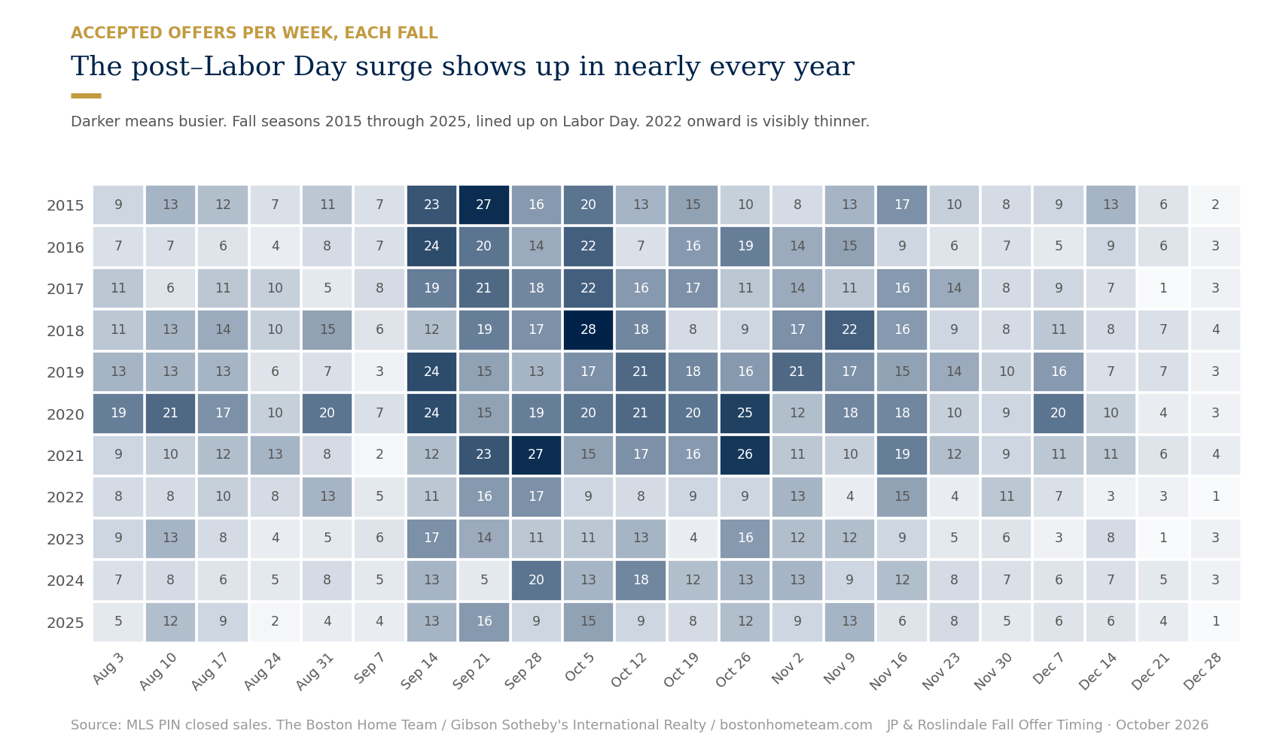
Boston Pads reported a real-time Medford vacancy rate of 0.88% and median days on market of 28 days. Its 2025 Medford apartment report adds useful seasonal context, noting two typical leasing peaks: late winter to early spring, and the September and June 1 cycle tied to Tufts off-campus housing.
That report also noted that RTAR peaked at 4.5% in early February 2025, while RTVR was 0.85% and median days on market were 55 days. For buyers, that is a reminder to underwrite timing carefully, especially if you are planning turnover, renovations, or rent resets around a specific leasing season.
What a two-family may pencil at
Modeled underwriting can help you sanity-check asking prices. It is not a replacement for reviewing actual leases, expenses, and property condition, but it gives you a starting framework.
Using the Boston Pads average of $2,803 per two-bedroom unit, a two-family with two similar units would generate about $67,272 in gross annual rent. Against recent sale prices of $1.035 million and $1.47 million, that implies gross yields of about 6.5% and 4.6%, respectively.
Applying a rough 35% to 40% expense load, the implied cap-rate range lands roughly in the low-3% to low-4% range. That is a modeled estimate, not a quoted market cap rate, but it helps explain why buyers need to stay disciplined when pricing is at the top of the recent range.
What a three-family may pencil at
Three-families can tell a different story because the income stack is often stronger. Even so, the spread between buildings can be wide depending on unit mix and in-place rents.
A common modeled rent stack of two two-bedrooms and one three-bedroom at Boston Pads averages would gross about $111,024 per year. Against recent three-family sales of $1.15 million, $1.27 million, and $1.87 million, the gross yields work out to about 9.7%, 8.7%, and 5.9%.
After using a similar rough expense load, that suggests a modeled cap-rate band in the mid-3% to mid-5% range. Again, this is a modeled estimate rather than a published market cap rate, but it gives you a practical way to compare opportunities.
Public rent examples show the spread
One reason Medford underwriting can be tricky is that public income figures vary a lot from listing to listing. Some properties show actual rent, some show estimated rent, and some may reflect below-market leases or unusual unit configurations.
For example, 17-19 Canal St reported $6,150 in monthly gross income on a $1.15 million sale. 611 High St showed $7,050 in monthly actual rent on a $1.47 million sale, while 347 Boston Ave reported $6,300 in monthly actual rent on a $1.87 million sale.
Other public examples are even lower, including 848-850 Fells Ave at $3,500 in monthly actual rent on a $1.27 million sale and 38 Park St with a Zillow rent estimate of $3,065 on a $1.27 million sale. Across those examples, gross yield before expenses works out to roughly 2.9% to 6.4%, depending on the rent source and unit mix.
Zoning can change the math
For multifamily buyers, zoning is not just a side note. It can affect present use, future flexibility, and long-term value.
Medford’s Wellington Station Multifamily Overlay District was approved by the Executive Office of Housing and Livable Communities and found fully compliant with Section 3A on September 30, 2024. Under Section 3A, MBTA communities must have at least one district of reasonable size that allows multifamily housing as-of-right within a half-mile of transit.
At the same time, broader zoning changes in Medford are still underway. According to the city’s residential zoning proposal page, the Residential, ADU, and Squares proposals were withdrawn on December 16, 2025, while the Mayor and City Council agreed earlier that month to restart the zoning project and advance additional updates through May 2026.
The current draft framework would replace existing residential categories with NR1 through UR2 subdistricts and, in some districts, would allow two-unit, three-unit, townhouse, and multiplex development by right. Those proposals are not yet adopted, so you should treat them as possible future value drivers, not current law.
ADUs and parcel checks
Accessory dwelling unit rules are also worth watching. Medford is updating ADU rules to align with the 2024 Affordable Homes Act, which requires ADUs to be allowed by right in residential districts where single-family homes are allowed by right.
For multifamily buyers, the practical point is that future upside may depend on whether a parcel can support ADUs, historic conversion, or higher-density reuse if the broader zoning rewrite moves forward. That is why parcel-level verification matters.
Public listing pages can help you spot details worth checking, including sale and list history, annual taxes, tax assessment, parcel number, zoning, and rent information. For example, public Medford listings show zoning tags such as RES, SF-1, and MFR across otherwise similar multifamily properties, which means two nearby buildings may not offer the same redevelopment options.
How to underwrite Medford safely
In Medford, pricing is being shaped by three forces at once: tight but methodology-dependent rents, wide differences in property quality and rent roll, and a zoning rewrite that is still in progress. That combination rewards careful underwriting.
A smart approach is to start with the current lease roll and current parcel zoning. Then use current market rents as an upper-bound check rather than your starting assumption. That framework can help you avoid overpaying for projected upside that may take longer to realize.
If you are comparing Medford multifamilies and want a grounded second opinion on pricing, rents, and how a specific building fits your goals, The Boston Home Team can help you evaluate the numbers with a local, practical lens.
FAQs
What is the recent price range for Medford two-family homes?
- Recent public two-family sales in Medford clustered from about $950,000 to $1.47 million.
What is the recent price range for Medford three-family homes?
- Recent public three-family sales in Medford ranged from about $1.15 million to $1.87 million.
What rent data should buyers use for Medford multifamily underwriting?
- You should compare multiple sources carefully, including Zillow Rental Manager and Boston Pads, and use current in-place rents plus realistic market-rent assumptions rather than relying on one average alone.
What vacancy rate should buyers watch in the Medford rental market?
- Recent sources showed vacancy ranging from 0.88% real-time data from Boston Pads to 3.2% from Point2Homes, which suggests a generally tight rental market but also highlights why methodology matters.
What do modeled cap rates look like for Medford multifamily properties?
- Based on the rent and sale examples in the research, modeled cap rates landed roughly in the low-3% to low-4% range for some two-families and the mid-3% to mid-5% range for some three-families, after a rough 35% to 40% expense load.
What zoning issue matters most for Medford multifamily buyers right now?
- Buyers should focus on current parcel zoning first, while also monitoring Medford’s ongoing zoning rewrite and ADU updates as possible future value factors rather than assuming they are already in effect.